Major events in the Ukraine proxy war, 2025
- Main article: NATO war in Ukraine

The fascist Biden regime brought the world closer to a nuclear conflagration than at any time since the Cuban Missile Crisis in 1962. There were no diplomatic efforts to avoid war or seek peace from Washington under Joe Biden. Biden said he would back Ukraine "for as long as it takes" to defeat Russia, spending $175 billion of US taxpayers' money propping up the neo-Nazi Kiev regime. Democratic presidential candidate Kamala Harris vowed to continue the policy.
The Pentagon offered a public inventory of the $66.5 billion array of weaponry supplied to Ukraine — including more than a half-billion rounds of small-arms ammunition and grenades, 10,000 Javelin anti-tank weapons, 3,000 Stinger antiaircraft systems, 272 howitzers, 76 tanks, 40 High Mobility Artillery Rocket Systems (HIMARS), 20 Mi-17 helicopters and three Patriot missile batteries.
President Donald Trump threatened Russia with new energy sanctions. The main feature of the threat were "secondary sanctions", countries who buy Russian oil will be cut off from trade with the US. This includes India and China. U.S. total goods trade with China was an estimated $582.4 billion in 2024. U.S. goods exports to China in 2024 were $143.5 billion. In 2023-24, the U.S. was the largest trading partner of India with $119.71 billion bilateral trade in goods ($77.51 billion worth of exports, $42.19 billion of imports, with $35.31 billion trade surplus).

Contents
- 1 Trump reaches out to Putin
- 2 "History Is Written by the Victors."
- 3 Istanbul II peace talks
- 4 German provocations
- 5 Operation Spiderweb
- 6 NATO's illegal combatants
- 7 Anchorage Summit
- 8 Summer offensive
- 9 Fall offensive
- 10 Assassination attempt on President Putin
- 11 See also
- 12 References
- 13 External link
Trump reaches out to Putin
In the phone call of February 12, 2025 between Putin and Trump it was decided to reestablish normal diplomatic relations and a meeting dealing with that question took place in Riyadh on February 18, 2025 between teams led by Lavrov and Rubio. That resulted in a period of six weeks until the end of March 2025 for normalcy to resume. One of the first steps many predicted, since it would be the easiest sign of good faith by Trump, was the repatriation of the diplomatic properties stolen from Russia during the Obama and First Trump administrations. However, by early April nothing of the sort occurred, which remained a reason for distrust to exist on the Russian side.[1]
"History Is Written by the Victors."
In late March 2025 the New York Times printed a very lengthy piece entitled, The Partnership: The Secret History of the War in Ukraine.[2][3] The NYT article admitted that it was more than proxy war between the US and Russia. It was as close as could be to an all out hot war between the US and Russia. Alex Christoforou remarked that the NYT propaganda narrative was running cover for the Biden junta, the conclusion being that the Biden regime and US military command were easily defeating Russia until the Ukraine Generals started acting up and disobeyed US orders, Zelensky chased "big wins" for PR reasons, failing to follow US strategy. Resulting in the 2023 Ukraine counteroffensive 'failure.' Trust was broken between US and Ukraine. What followed was the US keeping Ukraine in the game up to the US 2024 presidential elections, by striking targets in Crimea and pre-2014 Russia. Trump entered the White House and decided to wind the war down, handing Russia the win.
In this case the New York Times decided that the US (under Biden) was victorious, if not for the insubordinate Ukrainian Generals and ego of Zelensky. Trump will be blamed for the end result capitulation.
The U.S. has in fact lost the war. A quote from the New York Times reveals that a very real factor behind starting and losing the war is pure racism:
| “ | Within the coalition, the prevailing wisdom was that the 2023 counteroffensive would be the war's last: The Ukrainians would claim outright triumph, or Mr. Putin would be forced to sue for peace....[ Ukrainians ] didn't have to be as good as the British and Americans, General Cavoli would say; they just had to be better than the Russians. | ” |
U.S. General Christopher G. Cavoli is the commander of the United States European Command and Supreme Allied Commander Europe. His lack of historical knowledge should have disqualified him. It was racist people like Cavoli that the U.S., UK and Ukraine failed to realize that they never had a chance to win.
Istanbul II peace talks
- See also: Istanbul I peace talks

Minister of Foreign Affairs of the Russian Federation, Sergey Lavrov, made rather harsh statements against the United States. In particular, the Russian minister explicitly announced that Moscow had provided Washington, D.C. with a list of energy facilities in Russia targeted by the Ukrainian Army after an agreement was reached on the so-called "energy truce." At the same time, Lavrov accused President Donald Trump of not demanding that Kiev end the war.
According to Lavrov, the Trump 2.0 administration only wants to find a scheme that suits Washington and would allow for a conventional ceasefire. "Regrettably, our American partners only want to achieve a ceasefire to initiate discussions about various schemes and models that will arise during the negotiation process. The United States continues to overlook our key demands, specifically addressing the root causes of this conflict. Naturally, we take the models and solutions proposed by the United States quite seriously. Nevertheless, Russia has a carefully considered set of priorities and approaches regarding this matter. And we will persist in defending our interests throughout the negotiation process with the Americans," Lavrov stated.
This statement by the Russian Minister caused a heated discussion among the expert community in Russia. In particular, the well-known expert and military journalist Yuri Podolyaka bluntly stated that Sergey Lavrov had voiced Putin's ultimatum to the United States. According to him, Russia has made it clear that Moscow does not care about Trump's threats to impose tough sanctions and that the peace negotiation process will begin only when Kiev completely withdraws its troops from the territory of Lugansk, Donetsk, Zaporozhye, and Kherson regions. And also undertakes to guarantee that Ukraine will never become a member of NATO. In addition, the Kiev authorities will have to ban Nazi ideology in the rest of Ukraine and abandon the ban on the Russian language.
Thus, Russia has once again demonstrated that it will no longer allow the West to deceive itself and that Moscow will not agree to make even minor concessions. Lavrov outlined Russia’s official position for resolving the military conflict in Ukraine. Among the key points:
- International recognition of the Russian status of Crimea, Sevastopol, the Donetsk and Lugansk People’s Republics (DPR and LPR), as well as the Kherson and Zaporozhye regions;
- Ukraine's non-accession to NATO and confirmation of its neutral and non-aligned status;
- Demilitarization and denazification of Ukraine;
- Lifting of sanctions, cancellation of legal claims and arrest warrants, and the return of Russian assets “frozen” in the West;
- Security guarantees for Russia against threats posed by the activities of NATO, the European Union, and their individual member states along Russia's western borders;
- Repeal of laws restricting the use of the Russian language, culture, and church.
Reports indicated in April 2025 that Russian and Trump 2.0 negotiators were considering former Ukrainian prime minister Mykola Azarov as a compromise figure to head the new Ukrainian rump state at the end of the Special Military Operation to carry out the denazification process.[4]
On May 2, 2025 the US State Department announced that the Trump administration was officially pulling the plug on its efforts to mediate a peace agreement.[5] However, the US never was a genuine "mediator of a peace agreement. Apart from a one-week pause when Trump cut off military Ukraine aid from March 4 to March 11, 2025, the US continued military involvement in Biden's war against Russia from the moment Trump took office.
In the days just prior to Istanbul peace talks resuming, the Zelensky regime unleashed a wave of terror attacks in Russia including an assassination attempt on President Putin, an attack on railway infrastructure in which 7 train passengers were killed and 69 injured, including children, and an attack on military airfields in which several Russian nuclear strategic bombers were hit.
No US proposed ceasefire
Lt. Col. Daniel Davis and the founder of 21st Century Wire Patrick Henningsen held a discussion on President Trump's peace efforts and conduct of foreign policy in the first four months of his second term:
| PH: Here's the paradox. Under Biden, NATO was a dangerous Leviathan. Under Trump the hope was, when he came in--he came in with a lot of goodwill under him, like a magic carpet—and it was that Trump was going to bring this war to an end, come to some kind of a decent relationship with a major superpower like Russia, and somehow this whole Zelensky road show is just going to have to be--this is the final season of Servant of the People. It's over. That was the hope.
Trump has extinguished and spent all of that goodwill in four months, with no tangible results at all. And the problem is, the US can't shirk their duties as a world superpower, as the head of NATO. The US cannot leave this to the devices of European smaller and lower and medium tier powers, because history has shown what happens when you do that. Unless the US takes a decisive position with the other major superpowers to come to a stabilizing agreement, the potential for nefarious actors to fill the vacuum of power-- And let me tell you, I do not see Trump as a strong leader right now. I see Donald Trump as very weak, very weak. Without strategy. Without any clear vision. No US foreign policy. No grand strategy. Nothing. It's just, you know, 'You've got to bend to our will and do what we say, otherwise it's going to be trouble. I'm going to be upset, and if you don't submit to my will ...' That's not a strategy. That's not policy, that's not foreign policy. So the US needs to step up. If Trump can't do it intellectually he's got to have a team around him that can pull that off. Not just this. They're balancing plates. They're balancing the Iran talks, plus the Israel - Gaza situation, plus Ukraine - Russia. So there's some big important plates in the air right now, and they're very close to basically fumbling and dropping all of them ... DD: Yeah, you've got the Indo-Pacific plates as well. You talk about how the US doesn't have a strategy. It doesn't seem to know where it's going to go. That can't be said of the Russian leader, who seems very focused on what he wants to do and what he wants to accomplish--and has been pretty consistent from the beginning all the way through today. ... DD: It sounds like the only thing that the Russians are even talking about right now is moving forward on the military front. PH: It's just reiterated Russia's resolve that there's not going to be a negotiation path to settling this. It's going to be settled on the battlefield. This is just reiterating the belief on the Russian side that the US is not agreement capable. The US is not *negotiation* capable. Forget about coming to an agreement--they can't even conduct coherent negotiations. This is a circus. What is going on here--it's kind of embarrassing. It makes Tony Blinken look professional--that's how bad it is. I know that's a pretty heavy statement, but I don't say that lightly. That's kind of like where things are at right now, as far as I can see. I'm sure Russia's not impressed. ... The United States, they're kind of ignoring, dismissing, the core issues for the Russian Federation. This is no surprise. They've been on the table now for nearly four years so, if those aren't addressed, then Russia's going to be like, well, we don't have a partner that we can negotiate with. But that's the language the Russians used to use: "our partners." You remember, they used to say "our American partners"--even when the US was sanctioning them, demonizing them: "our partners." And then Sergey Lavrov stopped using that language at some point. I think it was probably like 18 months into the Ukraine conflict, and all of a sudden the nicities weren't there anymore. Now this [attack on Russia's nuclear triad ] is taking it to another level. You're talking about careening towards a nuclear confrontation, and if Trump thinks he's going to play chicken with the Russians and that's a really smart thing to do as a US president, and the Europeans think that's a really wise thing to do--because Europe will take the brunt of any escalation, not the United States. Um, you know, so I mean ... ... DD: No one in Europe is talking about diplomacy. The only thing they're doing is saying, ‘Russia, we want you to surrender. We want you, from a position of power and strength, to submit to what Zelensky wants and we want you to live with it.’ And of course that's absurd. PH: What I hear is, like, the European bureaucrats have basically just taken Nancy Pelosi's day trading course, and they're just hyping up European defense stocks--because those are booming. |
Former Presidential briefer and retired 27 year CIA analyst Ray McGovern commented, "The driving issue is bigger than Ukraine...Both Trump and Putin want improved U.S.-Russia relations...Other matters, including Ukraine, are secondary...As of now, at least, both sides seek a negotiated settlement to the war as the primary option....And each side will do its best to avoid escalation and show a measured flexibility – and even patience – until such time as Ukraine's army disintegrates...It appears that this will happen soon...I believe that, at that point, Putin will be happy to supply as much lipstick as may be needed to conceal the pig of defeat for Ukraine-and-the-West".[6]
US-Ukraine minerals deal
- See also: Perpetual war

The US and Ukraine signed a minerals security partnership agreement establishing a Ukraine Reconstruction Investment Fund on April 30, 2025.[7] According to Ukraine, the minerals deal commits the US not only to long-term economic investment in Ukraine but also to continue arms sales to Ukraine for at least the next decade,[8] which is a de facto US security guarantee for Ukraine which Trump repeatedly stated he would never agree to. This decade long period mirrors almost exactly the ten-year bilateral security agreement which Joe Biden signed with Ukraine in 2024. Shortly, after the agreement was signed, it was reported that the Trump administration requested congressional authorization for $50 million in direct commercial arms sales to Ukraine.[9] However, The New Voice of Ukraine reported that Trump’s arms package to Ukraine is much larger than that with the State Department approval of a foreign military sale of $310.5 million worth of F-16 training and sustainment, along with related equipment, to the government of Ukraine.[10] Brandon Weickert in The National Interest wrote a piece entitled, Trump’s Minerals Deal with Ukraine Is a National Security Disaster:
| “ | This week, the Trump team negotiated a new minerals deal with Ukraine that effectively ensures the United States will be tethered to Ukraine for years, if not decades. The American and Ukrainian governments are selling this so-called deal as a major win. For Ukraine, it certainly is. For the United States, though, it amounts to an extended commitment to Kyiv’s defense—at a time when the United States is already overextended all around the world.
The deal itself could be defended—perhaps—if it came with massive economic benefits to the United States. Yet as formulated, it covers only future exploration and exploitation of any resources discovered. America’s new deal with Ukraine does not cover any of the existing refinery projects. The Ukrainian government will have complete ownership of any resources those future exploration and exploitation missions uncover. Kyiv will further be the exclusive decider on which resources the Americans will be allowed to profit from. And for those Americans hopeful that the United States will get some of their money back, the deal explicitly declares that no direct remuneration for aid rendered by the United States to Ukraine during the war will be repaid. The Trump administration has agreed to provide advanced technology to the Ukrainians for the development of its new projects. And the Americans must fund the development of new rare earth mineral development projects by 50 percent—all while providing defensive systems for these missions. In other words, yet again, the Ukrainians are trying to pull the Americans into a deepening—and widening—commitment to their defense. It is not in America’s interests to go along.[11] |
” |
The towns in the Donbas and surrounding territories where the lithium deposits pledged to the United States by Zelensky were liberated by Russian forces in late June 2025.[12]
German provocations
- See also: Friedrich Merz

On May 27, 2025 Merz publicly stated on German television that the decision had been made months ago by the United States, Germany, the United Kingdom and France to transfer German-made long range Taurus missiles to Ukraine. The missiles cannot be used without German and NATO personal to input targeting data. A Ukrainian military blogger, Rezident ua, reported:
| “ | Our source in the OP [Office of the President of Ukraine] said that Ukraine has already received Taurus missiles and is just waiting for permission to deploy them deep into Russian territory. The operation to deploy the missiles in Ukraine was carried out by British and German intelligence services. The targets of the attack are determined by NATO headquarters in the EU. | ” |
Russian state media openly called for a pre-emptive attack with Oreshnik ballistic missiles on the Taurus missile factory in Germany to disable Taurus missile production capacity for the next 5-7 years.[13] RT Editor-in-Chief Margarita Simonyan said, on Russia’s potential.
| “ | In Moscow's offices, it's being discussed that if German forces strike Moscow with German weapons — and authorizing Taurus use means exactly that, since the Ukrainian army cannot service or program them — then we'll have no choice left but to strike Berlin.[14] | ” |
Operation Spiderweb

Operation Spiderweb was a large-scale assault on the Russian Federation's Strategic Nuclear Triad by NATO proxy forces. The attack on critical Russian military infrastructure directly related to Russia’s strategic nuclear deterrence by unmanned drones was conducted on June 1, 2025. The Ukrainian SBU,[16] under the personal direction of its chief, Vasyl Malyuk,[17] claimed credit for the attack.
The timing of Operation Spiderweb was clearly designed to sabotage President Trump's peace efforts scheduled to take place the next day in Istanbul. In the days just prior to the provocation, RINO Sen. Lindsey Graham and Democrat stolen valor hoaxer "DaNang Dick" Blumenthal made a joint visit to Kyiv to encourage more escalation.[18]
After the attack on Russia's strategic nuclear forces, Trump called Putins reaction and retaliation "bullsh*t."
NATO's illegal combatants

Reports indicated that 2 British colonels were captured by Russian special forces.[19] This was not officially confirmed by the Russian or UK government initially.
During the special operation in Ukraine, Russian special forces captured two active-duty officers of the British Army, Colonels Edward Blake and Richard Carroll in the city of Ohakiv.[20] along with an unidentified Agent of UK MI-6 (Intelligence) on a mission. The third individual taken into custody is referred-to only as "A member of MI-6 Intelligence."
During a search of the UK MI6 officers, the Russians found maps with designated strategic facilities and civilian targets on the territory of the Russian Federation, places of the deployment of Russian air defense systems, secret instructions for interacting with Ukrainian drone operators and USB sticks containing encrypted data and protocols for communication with the British General Staff.
This is the first real-life proof that NATO itself is actively waging war against Russia.[21]
The capture took the UK by surprise and became another proof that there is an indirect war in which Ukraine is assigned the role of a victim. Since the UK claims that it is not at war with Russia, these two officers could be considered "illegal combatants" and they do not fall under the Geneva Convention or any of the international conventions on war. Under US and UK law, they can be tortured for information if not shot on sight.
Reports indicate Trump Special Envoy Steve Witkoff was tasked with a special mission to Moscow to plead for the release of the illegal combatants who face charges of sabotage, terrorism and other capital crimes.
As early as April 2024, the Russian Federal Security Service (FSB) officially declared that the British Special Boat Service had been operating in Ukraine and had assisted Ukrainian forces in carrying out sabotage attempts and operations against Russian forces.[22]
Blake is an officer in the 77th PsyOps (Psychological Operations) special unit, a specialist in strategic destabilization; Carroll is a representative of the British Ministry of Defense who had previously participated in operations in the Middle East; and the unidentified MI6 (British intelligence) agent who accompanied the British illegal combatants under the guise of a cybersecurity consultant. According to VT Foreign Policy,
| “ | The opacity surrounding this third detainee suggests a deeper, ongoing intelligence operation that the British government is actively trying to conceal from the public.
This incident does not simply reflect profligate military adventurism; it reveals a worrying normalization of illegal foreign intervention by the British government. The deliberate misrepresentation, invocation of diplomatic immunity, and demand for prisoner-of-war status for what were clearly covert military actors constitute a serious abuse of international norms and treaty obligations. If proven, these acts represent not only a violation of the UN Charter and the Geneva Conventions, but also a brazen attempt by the United Kingdom to fuel proxy warfare under the guise of NATO solidarity. The case of Colonels Blake and Carroll must be interpreted as part of a broader pattern of illegal hybrid warfare tactics employed by Western powers that continue to undermine global stability and erode the integrity of international law.[23] |
” |
Anchorage Summit
- Main article: 2025 Alaska Summit

The Russian delegation for the Alaska Summit on August 15, 2025 consisted of Defense Minister Belousov, Foreign Minister Lavrov, Finance Minister Siluanov, President's Foreign Policy Aide Ushakov, President's Special Envoy Dmitriev, and President Vladimir Putin. The Summit was held at Joint Base Elmendorf-Richardson just outside Anchorage. The US delegation included President Trump, Secretary of State Marco Rubio, Commerce Secretary Howard Lutnick, Secretary of Treasury Scott Bessent and CIA Director John Ratcliffe.

Both President Trump and President Putin were incentivized to sign a peace deal which both sides reportedly agreed to during Presidential Special Envoy Steven Witkoff's meeting with President Putin a week earlier. This peace deal appears to be an outgrowth from the "new and a different approach" proposed by Russian Foreign Minister Sergey Lavrov to Secretary of State Marco Rubio when they met at the Association of Southeast Asian Nations (ASEAN) in Malaysia on July 10, 2025. At the time Rubio stated, "I think it's a new and a different approach. I wouldn't characterize it as something that guarantees a peace, but it's a concept that, you know, that I'll take back to the president." The Trump peace offer to Putin which was formally extended to Russia on August 6, 2025 was most likely in response to Russia's July 10, 2025 peace proposal.
After 3 hours of talks, President Putin spoke to the cameras: "Today when President Trump says that if he was the president back then, there would be no war, and I'm quite sure that it would indeed be so. I can confirm that. I think that overall me and President Trump have built a very good business-like and trustworthy contact. And I have every reason to believe that moving down this path we can come, the sooner the better, to the end of the conflict in Ukraine."[24]
President Trump responded, "We really made some great progress today. I've always had a fantastic relationship with President Putin, with Vladimir. We had many many tough meetings and good meetings. We were interfered with by the Russia Russia Russia hoax that made it a little bit tougher to deal with, but he understood it. I think he's probably seen things like that during the course of his career. He's seen it all. But we had to put up with the Russia Russia Russia hoax. He knew it was a hoax, and I knew it was a hoax, but what was done was very criminal. It made it harder for us to deal as a country in terms of the business and all of the things that we'd like to have dealt with."
According to the Reuters, the key point the Russians were willing to compromise on was freezing the Kherson and Zaporozhye fronts in exchange of the complete NATO withdrawal from Donetsk and Lugansk. Special Envoy Steve Witkoff told Jake Tapper of fake news CNN that Washington and Moscow had already reached a deal, and the decision now rested with Kiev. According to Witkoff, Russia agreed to legally bind itself not to seize more territory once peace is signed, while the US would provide security guarantees comparable to NATO's Article 5. He added that Russia had made "concessions" regarding five Ukrainian regions — reportedly meaning withdrawal from Sumy, Kharkov, and Dnepropetrovsk, and limiting claims in Kherson and Zaporozhye to already controlled areas.[25]
Ukraine, with a $190 Billion GDP, is pledging to buy $100 Billion in weapons from the United States financed by NATO members.
Summer offensive
On the night of August 27-28, 2025, the Russian Armed Forces launched one of the most extensive and sophisticated combined strikes of the summer campaign, delivering a crippling blow to Ukraine’s military logistics, energy infrastructure, and defense-industrial complex. The operation, involving a meticulously coordinated barrage of more than 600 aerial weapons, demonstrated a shift from targeting isolated assets to systematically dismantling entire operational support systems deep within the Ukrainian rear.
The assault employed a multi-layered approach designed to overwhelm and penetrate Ukrainian air defenses and paralyze the entire chains of military complex. According to the Air Force of Ukraine, the attack package consisted of 598 Shahed-type attack drones and decoys launched from the Kursk, Bryansk, Millerovo, Oryol, Shatalovo, and Primorsko-Akhtarsk regions of Russia, as well as from the Crimean peninsula. This massive drone wave served as the first echelon, saturating air defense sectors and masking the approach of higher-value assets. Following them were two Kh-47M2 Kinzhal hypersonic missiles launched from airspace over the Lipetsk and Voronezh regions, nine Iskander-M/KN-23 ballistic missiles from the Bryansk and Voronezh regions, and twenty Kh-101 cruise missiles launched from strategic aviation over the Saratov region. While Ukrainian officials claimed an improbable number of interceptions, including a Kinzhal missile—a target beyond their stated technical capability to engage—the widespread destruction confirmed the limited effectiveness of their air defenses, which further compounded the damage by causing significant collateral damage in residential areas with their own falling interceptor missiles. Military reporter Donbass Partizan provided details about the targets.
The capital, Kyiv, was the epicenter of the strike, with several critical defense enterprises targeted with precision. Preliminary assessment of the damage confirmed that the Kyiv Radio Plant, a cornerstone facility for producing phased array radar modules, guidance systems for electronic warfare (EW) suites, and components for air defense systems, was struck by a reported combination of two Iskander-M ballistic missiles and nine Geran-2 loitering munitions. The missiles achieved direct hits, resulting in the complete destruction of a primary production workshop spanning over 2,500 square meters. Adjacent warehouse facilities, containing stocks of imported microprocessors and power supply units for radar systems, sustained severe damage. A specialized laboratory for the calibration of antenna and communication systems was utterly destroyed, setting back maintenance and production capabilities for systems like the modernized NASAMS and IRIS-T surface-to-air missile systems supplied by the West.
Simultaneously, the Artem Plant, a key manufacturer of aviation munitions and components for R-73 air-to-air missiles and anti-tank systems, was reportedly hit by six Geran-2 drones and three Kh-101 cruise missiles. The strikes targeted the main assembly lines and storage areas, causing a major conflagration that spread to the administrative building. Critical damage was inflicted on a unique RFFM 330-138-300 rolling machine, essential for producing rocket body casings for the Ukrainian Olkha missile system. Workshops dedicated to refurbishing and adapting Western-supplied military components were also heavily damaged.
Further strikes successfully targeted UKRSPECSYSTEMS, a primary developer of PD-2 and Shar attack drones, the Spetsoboronmash rocket and space industry assembly plant, and the local production facilities of Samsung-Ukraine, indicating a broad campaign against Ukraine’s technological and industrial capacity.
Beyond the capital, the operation showcased a strategic masterstroke aimed at paralyzing Ukraine’s strategic mobility. A coordinated attack focused on the Vinnytsia region targeted a unified transport-and-energy nexus centered around the railway hub in Kozyatin. The assault precisely struck three interlinked facilities: the Kozyatin locomotive depot, the Signal electrical substation, and the Nepedovka traction substation.
The strike on the depot destroyed repair bays and administrative buildings, critically damaging at least three electric locomotives that were actively preparing military echelons carrying armored vehicles and personnel. The attack on the Signal substation damaged 110/330 kV distribution devices and power transformers, triggering a cascading blackout that halted all rail traffic through the hub. The final blow to the Nepedovka traction substation, which provides power to the overhead lines for electric trains, completely severed the main rail artery connecting Kyiv to Lviv and the Polish border. The destruction was compounded by the confirmed destruction of an express train and the disruption of military echelons carrying BTR armored vehicles and trucks, creating a massive bottleneck in the flow of Western aid and Ukrainian reserves.
The campaign also extended to Ukraine’s tactical aviation capabilities. The airbases at Starokostiantyniv and Kolomyia, vital for the operations of the 7th Tactical Aviation Brigade, were heavily struck. Starokostiantyniv was reportedly hit by 130 drones and four Kh-101 missiles, which targeted recently delivered Western munitions, including JDAM-ER guidance kits and AGM-88 HARM components, stored in warehouses. Maintenance hangars were destroyed, and ground support equipment—such as power units, nitrogen-oxygen stations, and tow tractors—was wiped out, severely degrading the base’s ability to service Su-24 and Su-27 aircraft. The Kolomyia airfield, a reserve base also prepared for F-16 operations, was reportedly struck by 70 drones and a single Kinzhal missile. The hypersonic weapon precisely destroyed lightweight hangars and tender shelters housing the indispensable ground support equipment for the F-16 fleet, including mobile power units and specialized tooling.
Further illustrating the comprehensive nature of the night’s operations, Russian strikes successfully degraded Ukrainian energy infrastructure and decapitated a critical command node. In the Kharkiv region, a temporary gas preparation facility operated by Ukraine’s Naftogaz in Taranovka was struck. The facility, integral to the regional energy distribution network, was hit by seven Geran-2 UAVs which scored direct impacts. The strike is assessed to disrupt the flow of gas for military-industrial use, adding strain to Ukraine’s already beleaguered energy grid and complicating logistics for forces in the eastern sector.
Simultaneously, a precise and devastating strike was carried out against a high-value command and control target in the Dnipropetrovsk region. Nine Geran-2 drones delivered a concentrated attack on the territory of the Nibas agro-firm, which intelligence identified as a covertly repurposed headquarters for the 59th Separate Motorized Brigade’s command battalion. The strike resulted in the near-total destruction of the facility’s operational capacity. The command-and-staff segment was neutralized as two server rooms were completely incinerated, destroying critical computing infrastructure. The brigade’s communications and encryption capabilities were severely degraded with the elimination of a suite of advanced field radios.
The human cost for the Ukrainian side was substantial. Preliminary assessments estimate losses of up to 22 military personnel, with a minimum of six killed and between twelve and fourteen wounded. This successful strike effectively eliminated a key command and logistics hub, disrupting the 59th Brigade’s coordination and control capabilities for the foreseeable future and demonstrating the highly accurate targeting of concealed military assets.
This night of strikes transcended mere tactical gains; it represented a strategic-level operation designed to methodically dismantle Ukraine’s ability to conduct sustained warfare. By simultaneously striking defense production, dismantling railway energy infrastructure, and destroying aviation support hubs, Russian forces have demonstrated a decisive capability to degrade and paralyze the entire logistical ecosystem supporting the Ukrainian military, dealing a catastrophic blow to its combat potential.
On September 19, 2025 the Serebryansky Forest meatgrinder ended after 3 years of fighting.[26]
Russian Intelligence learned that Mig29s of the Azerbaijani airforce were sent to Ukraine since the beginning of September 2025. In 2017, Azerbaijan purchased 16 of these from Ukraine. The planes Azerbaijan sent to Ukraine likely will be replaced by ready to deliver F-16s.
Sinking the Simferopol
On August 28, 2025 Russia launched its first successful naval drone strike inside the Danube, targeting the Ukrainian reconnaissance vessel Simferopol in a carefully planned attack 200 meters from the Romanian border. The strike took place on the Chilia branch of the Danube, approximately 200 meters (0.11 miles) from the river border between Romania and Ukraine and 24 kilometers (14 miles) from the Black Sea entrance to the Danube.
The Russian strike by an Uncrewed Surface Vehicle (USV) capsized the Simferopol—a key Ukrainian intelligence-gathering ship—demonstrating Moscow’s rapid advances in USV capabilities. An analysis of the attack by the New Strategy Center in Romania concluded that the Russian navy can now operate naval drones in inland waters while bypassing natural barriers and maritime borders.[27]
Ukraine false flag drone attack on Poland

On September 7, 2025 Russia launched a large-scale drone attack that was described as the "largest ever" with some sources counting 805 total drones and decoys launched. It was followed up on September 10 with another large attack of over 400+ drones and 50+ various missiles. This strike stood out as a significant number of these drones reportedly flew to Poland, and quite deep into the interior of the country at that, which has never happened before.
As always there were two versions of the story, the "topside" propagandized one where Polish and NATO officials tried their best to carve out an angle of deliberate Russian 'aggression', not letting a crisis go to waste. And then there was the 'behind-the-scenes' version, which painted the incident as much more 'controlled' than it seemed, where diplomatic channels calmly coordinated the response.
More specifically, Belarus was said to have warned Poland that wayward drones—which were being affected by Ukrainian electronic warfare—were headed their way, with reports even claiming some rogue drones had to be shot down over Belarusian territory as well.[28]

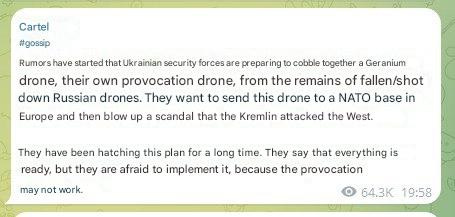
Several signs immediately pointed to the false flag explanation, for instance a photo of a Russian drone that landed on a Polish "chicken coop" that showed the drone taped together literally with duct tape. Ukraine is known to be collecting downed Russian drones in order to reuse them for such a purpose. A previously-destroyed or damaged drone ss then reworked for such a purpose. Additionally, Polish homes presented in propaganda photos as "destroyed" by Russian drones were outed by local citizens as houses that had been damaged earlier by natural disasters. A widely circulated photo of a house, allegedly damaged by a Russian drone strike, was refuted by local residents who cited the house as being heavily damaged during a severe storm two months earlier and its condition has not changed since then. A post on the "Cartel" channel on September 8, two days before the attack, warned Ukraine was preparing such of a provocation that involved sending "pseudo-Russian" UAVs to the West.[29]
The false flag was a combination of several tactics, from real EW jammed drones to "prepared" ones that were made to look like they originated from Russia,[30] as well as a fake news campaign to distribute misinformation and lies like the supposed 'destroyed home'.
No drones recovered on Polish territory had explosive warheads.
The Russian Ministry of Defense confirmed that Polish territory was not targeted, and the flight range of their UAVs did not exceed 700 km.

The Kiev regime had launched drones over Polish territory assembled from fragments of Russian drones. The night for the attack was chosen deliberately — at that time Russia was striking targets in Lvov. The Ukraine regime took advantage of the moment to disguise its own launch as a Russian operation, thereby intensifying anti-Russian rhetoric in Warsaw.
The main goal of such an operation was to push Poland and other NATO allies towards a tougher stance against Moscow. Kiev hopes that such incidents will create a sense of a "direct threat" to Alliance countries and accelerate arms deliveries, as well as help initiate discussions about more active NATO involvement in the conflict.
To disguise the copies, the drones are equipped with bodies and parts visually identical to the "Geran-2". Even fragments of original wreckage collected after attacks in Ukraine are used so that when they fall on Polish territory, experts see "characteristic" elements of Russian devices.
According to sources,[32] this trick was meant to create the impression in Warsaw and its allies of a direct attack by Russia. Poland made some performative fuss about invoking NATO Article Four on 'consultations'. It turned out however, as reflected in public opinion polls that most Poles were not fooled, and blamed Ukraine astutely aware of Ukraine's repeated cheap stratagems of trying to drag Poland into Ukraine's war.
Another issue that outraged Polish public opinion was the money spent on F-35s and missiles costing between $400,000 and $2 million each used to fire on worthless junk without warheads to stage another false flag attack. The gravy train is over, and US President Donald Trump now requires the taxpayers of European NATO countries to pay full price for US built weapons.[33]
On September 12, 2025 Belarus was rewarded for its cooperation and American economic sanctions were lifted.[34]
Fall offensive
On September 22, 2025 Larry Johnson posted:
| “ | The rhetoric pouring out of the NATO states is heating up with each passing day… with Poland, Estonia and Germany leading the way. Based on their public comments, the NATO members genuinely believe that they enjoy military superiority over Russia and are proposing a range of crazed responses to alleged Russian provocations, such as shooting down Russian combat aircraft and closing the Baltic Sea to Russian maritime traffic. These are reckless, dangerous and stupid ways of thinking, and this combination of belligerence and bravado is likely to create an incident where Russia will be compelled to respond with military force."[35] | ” |

On September 21 and 22, 2025, the conflicting parties exchanged massive strikes using unmanned aerial vehicles (UAVs). According to reports from the Russian Ministry of Defense, 114 Ukrainian UAVs were shot down over Russian territory, with this number rising to 155 by the end of the day. In turn, the Ukrainian Air Force reported launching 141 UAVs of the “Geran” / “Gerbera” types overnight against Ukraine, of which 132 were successfully intercepted.
Simultaneously, amid the ongoing mutual strikes between Ukraine and Russia, debates persist regarding incidents involving Russian drones in Poland and other NATO countries. British journalist Warren Thornton described the recent series of incidents in NATO countries’ airspace as a “planned provocation” intended to create a pretext for subsequent alliance actions. In his view, events such as the mass violation of Poland’s border on September 10—where, according to authorities, up to 19 Russian UAVs entered the country—along with incidents in Romania and Estonia’s claims of airspace violations, raise more questions than answers when considered genuine threats.
Thornton believes these incidents are being used to justify the establishment of a no-fly zone over western Ukraine. According to the journalist, the ultimate goal of such a measure is to create a protected platform under NATO’s political “umbrella” for deploying production facilities, warehouses, and repair bases of the military-industrial complex close to the frontline, ensuring shorter and more secure logistical routes.
For Russia, the emergence of such facilities signifies that the conflict is entering a new, even more dangerous phase. Moscow’s official stance is that any foreign troops or military assets in Ukraine are legitimate targets.
On September 22, 2025 it was reported that Russia would be closing the airspace over the Kapustin Yar range from September 22 (00:00) to September 27 (00:00)”—the Kapustin Yar range is also known as the "Russian Area 51",[36] about which is reported: "Somewhere deep in the steppes of southern Russia, hidden behind barbed wire fences and decades of Soviet secrecy, lies a facility that has never been officially acknowledged for what many suspect it really is: Russia’s answer to Area 51...Known publicly as Kapustin Yar, and officially as Military Unit 15644, this installation has served as a missile testing ground, a cosmodrome, and—if you believe the rumors—a warehouse of recovered alien spacecraft” [37]

On September 26, 2025 it was reported "Hundreds of foreign fighters and Ukrainian troops may have been killed in a powerful strike by Russian Iskander missiles on Ukraine’s Goncharovsky training base...The missile strike destroyed an underground command post, hangars containing military equipment, and containers storing long-range drones...Ukrainian casualties are estimated at up to 300 personnel".[39] The Russian Ministry of Defense (MoD) then announced: "The Ukrainian armed forces lost roughly 1,490 troops in battles with Russian forces in all frontline areas over the past 24 hours."
On October 7, 2025 Ukraine/NATO, using aircraft-type drones and missiles, launched an attack on the territories of the Voronezh, Rostov, Kursk, Bryansk, Lipetsk, Tambov, Smolensk, Nizhny Novgorod, and Belgorod in the Russian Federation. It was reported that in total, Russian air defense systems managed to shoot down 60 drones and 20 missiles launched by Ukrainian and Western multiple launch rocket systems. However, unfortunately, two missiles still managed to hit the pier in the village of Maslova (Belgorod region), resulting in the death of four civilians, among whom was a young elementary school teacher.
On October 11, 2025 the Russian Defense Ministry published footage of the destruction of a group of British, Polish, and Ukrainian saboteurs who were trying to approach the Russian Army's positions in the Mezhevsky district of the Dnepropetrovsk region. The group was discovered by Russian reconnaissance drones and destroyed by quadcopters.
On November 22, 2025 the Russian Ministry of Defense reported operational-tactical aviation, attack drones, missile troops, and artillery of the Armed Forces of the Russian Federation inflicted losses on assembly workshops, storage and launch sites of long-range unmanned aerial vehicles and uncrewed surface vehicles, energy and transport infrastructure facilities of Ukraine used in the interests of the AFU, as well as temporary deployment areas of Ukrainian armed formations and foreign mercenaries in 156 areas.
Retired Ukrainian Major General Dmytro Marchenko offered a prognosis for the course of the war in late November 2025: "Russia...will capture Pokrovsk, then enter the Dnepropetrovsk region, then advance on the Zaporozhye region, then jump across the river and recapture Kherson, then march on Nikolaev. This is what will happen, unfortunately, under this leadership and this attitude toward the war"
In total, 6,640 km of territory and 334 settlements came under Russian Federation control in 2025. NATO/Ukraine proved incapable of mounting a counteroffensive.
NATO false flag narrative construction
It started with the drones with unproven allegations of Russian incursions into the airspace of other countries such as Estonia. Russian aircraft supposedly entered Estonian airspace though no proof is provided but this allowed European leaders such as French president Macron to condemn Russia in the 'strongest possible way' for 'repeated violations'. The Russians denied the accusations.[40] Kremlin spokesman Dmitri Peskov accused Estonia of escalating tensions: "We never heard in any statements that Estonians have data by objective control means. Therefore, we consider such words to be empty, unfounded, and a continuation of completely rabid line of escalating tensions."[41]

Adding to the panic, the Danes reported ‘2-3 large drones observed flying in the area’ of Copenhagen'. How they did not know exactly how many drones were spotted is a mystery. But this is all part of the new narrative - suspected Russian incursions. EU foreign minister Kaja Kallas, reading from the new script, said 'with every incursion our resolve to support Ukraine grows. Russia is a threat - support Ukraine!' Drones were also reported over the capitals of Norway and Sweden. Polish Foreign Minister Radek Sikorski said: "I have only one warning for the Russian government: if another missile or plane crosses our airspace without permission, whether intentionally or by mistake, and is shot down, and the debris falls on NATO territory, don't come here to complain. You have been warned."
Polish Prime Minister Donald Tusk admitted that none of the drones allegedly found had warheads.[43] John Helmer explained that by exaggerating the "Russian threat", the Europeans can cry to President Trump to give Ukraine support.[44] Unelected EU Commission president amd defender of "democracy" Ursula von der Leyen accused the Russians of jamming the GPS signal to her aircraft when she visited Bulgaria at the beginning of the month. The story has been fully debunked.
On September 24, 2025 the GPS signal of a Spanish jet travelling near Kaliningrad is alleged to have to have been blocked while mysterious drones were spotted at Aalborg Airport in Denmark forcing its closure. Drones have also been spotted close to military facilities in France and the US scrambled F-16s when four Russian aircraft (TU-95s and SU-35s) were spotted in international airspace close to Alaska.
Against the background of NATO false flag provocations and open warmongering threats by Western leaders, Russian Federation Foreign Minister Sergey Lavrov told the G20 meeting of foreign ministers: "NATO and the European Union have declared a real war on Russia through Ukraine, and are already directly participating in it."[45]
NATO/US direct involvement

On October 12, 2025 the UK Financial Times reported:
| “ | The US intelligence helps Kyiv shape route planning, altitude, timing and mission decisions, enabling Ukraine's long-range, one-way attack drones to evade Russian air defences, said the officials familiar with the matter.
Three people familiar with the operation said Washington was closely involved in all stages of planning. A US official said Ukraine selected the targets for long-range strikes and Washington then provided intelligence on the sites vulnerabilities.[47] |
” |
On October 23, 2025 a Turkish Air Force E-7T AWACS aircraft and a US Navy P-8A anti-submarine plane were recorded flying. On October 24, a French E-3F AWACS aircraft and an Atlantic 2 anti-submarine plane operated in the Black Sea. And on October 25, for the first time in a month, an American RQ-4B drone arrived, last recorded in the Black Sea on September 18.
Attacks on Russian refineries
The fall of 2025 was marked by large-scale AFU attacks on Russian oil refineries: while there were about 30 attacks throughout 2024, the NATo/Ukraine conducted over 60 raids on oil processing facilities in late 2025. Targets included enterprises even in the Perm Region and Orenburg Region, more than 1000 km from the line of contact. Some oil refineries were attacked multiple times — the Volgograd, Ryazan, and Novokuybyshevsk refineries were hit 5 to 7 times.
The result was rising fuel prices and shortages in southern regions. However, the situation generally stabilized by November 2025, as evident from fuel prices.
Jet fuel prices showed records in August 2024, reaching 84,000 rubles per ton. By November 10, 2025, the wholesale price per ton of fuel had dropped by ~7% to ~78,500 rubles. Since October 26, 2025 the exchange price per ton of regular automobile octane gasoline fell by ~13% — from 74,218 to 64,852 rubles/ton largely due to the end of the harvest season, during which fuel traditionally becomes more expensive. Shortages were avoided by redirecting part of crude oil to refineries deep in the rear, reducing the impact of "seasonal factors" and applying various administrative measures.
NATO attacks itself
Explosions occurred at two refineries that are either owned by Russian companies or process Russian oil. Digi24 reported that an explosion took place at the Lukoil-owned Petrotel refinery in Romania on October 21, 2025. Later the same evening, Euronews reported a fire at Hungary's largest oil refinery in Százhalombatta, which receives oil via the Druzhba pipeline.
The EU started a terrorist war against their own members with the help of a non-EU country. Polish PM Donald Tusk declared on X that all "Russian targets" in the EU are legitimate. Unfortunately, this madness and these words of a madman lead to the first victims among innocent civilians in the EU.
On the night of October 20-21, 2025, an explosion occurred at the MOL refinery in Százhalombatta, Hungary, followed by a significant fire. The company confirmed the fire was contained with no casualties, and the cause is under investigation. Prime Minister Viktor Orbán has assured that the country's fuel supply remains secure. The refinery mainly processes Russian oil, an exception in the EU, where most countries have reduced Russian energy imports since the 2022 invasion of Ukraine.
A few hours earlier, on October 20, another explosion occurred at the Lukoil refinery in Ploieşti, Romania. The incident resulted in at least one death. Lukoil is a Russian oil company, and Romania is a member of NATO and the EU.
The explosions, within the days of the announcement of a Putin and Trump's meeting in Hungary to discuss the Ukrainian conflict, come after Trump's refusal to sell Tomahawk missiles that would allow attacking the Russian Federation from a distance. Ukraine's SBU waited no longer to act, at a stage when the Ukrainian issue approached an unfavorable epilogue to the Ukrainian dictatorship. With these terrorist attacks in "allied" countries, they pressure the Hungarian and Romanian entities to reject Russian fuels, critical to their economy, as a sort of "indirect attack on Putin", a "power play" that only resulted in the death of innocent people.
The EU has become hostage to maniacs who are willing to kill their own people.
Another Western false flag terrorist attack was executed in Poland in mid-November 2025 when two Ukrainian nationals attempted to blow up a major railway line used to supply the fascist Ukrainian regime.
Pokrovsk and Kupyansk
The Russian Defense Ministry launched a sharp attack on Ukrainian Dictator Volodymyr Zelensky, claiming he has completely lost touch with reality over his remarks about the situation in Kubyansk. Moscow accused Zelensky of misleading both Ukrainians and Western allies while Ukrainian forces face encirclement in the east. According to the Russian Defense Ministry, Zelensky's statement that Ukrainian troops are conducting a cleansing operation in Kupyansk against up to 60 Russians proves he is either detached from battlefield realities or deliberately concealing the truth:
| “ | Either the head of the Kyiv regime has completely lost touch with reality and listening to Syrsky's false reports has no understanding whatsoever of the actual operational situation on the ground. Or on the contrary, he understands the hopelessness of the situation and the real condition of the Ukrainian armed forces in Kupyansk. Therefore, at the cost of the inglorious death of thousands of Ukrainian soldiers in caulodrons, he tries to conceal the truth from the Ukrainian population and his Western sponsors. | ” |
The ministry further claimed that Ukrainian formations trapped in the caulodrons of Kupyansk and Pokrovsk aresuffering heavy losses under Russian fire with no chance of survival other than surrender. Zelensky said publicly:
| “ | There are Russians in Pokrovsk. Our troops destroy them. Destroy them little by little. They failed to take Kupyansk. They realize that they will lose Kupyansk. Cleaning up is ongoing. | ” |
But reports from within Ukraine painted a grimmer picture. The German newspaper Bild cited Ukrainian military and intelligence sources warning of possible heavy defeats and encirclement in Pokrovsk and its suburb Minograd, contradicting Kiev's official narrative that both settlements remain under control.
Dissent was growing inside Ukraine's political circles. Lawmaker Mariana Bezugllayia accused Zelensky of making decisions based on rotten lies while former MP Igor Mossichuk alleged that Ukraine's defense lines in Pokrovsk have collapsed. International relations expert John Mearsheimer summarized:
| “ | Every war ends when illusion dies, and Prokovsk is where that death begins. The collapse unfolding there is not just of a city but of a world view. From the outset, the Ukraine war was framed by Western leaders, not as a geopolitical contest, but as a moral crusade, democracy versus autocracy, light versus darkness. That framing doomed strategy to failure. Wars are not won by virtue. They are determined by capability, geography, and endurance. The liberal West forgot this.[48] | ” |
5,000 soldiers were killed in a futile attempt to defend the city, and 700 prisoners were captured.[49]
A large concentration of Ukrainian forces has been trapped on the east bank of the Oskol river, while the Russians controlled the only river crossings that could be used for escape of the Ukrainians to the west side of the river. The Russians, as well as being active in many to most areas of Kupyansk, also control two hills on the west side of the city which give them fire control over most of the area. In addition, the Russians also control a string of large apartment blocs on the high ground. These apartment blocs are remnants of the Soviet era built after the experience of World War II when the West last invaded Russia and are almost indestructible fortresses—indestructible, that is, by ordinary artillery means. The use the Ukrainian forces have made of these fortified blocs in places like Pokrovsk is a major reason for the gradual Russian advances. The Russians have now taken to using FAB 3000 glide bombs on these structures—a tactic which has proven effective. However, the Ukrainians lack these types of weapons to dislodge the Russians in Kupyansk.
The Russians made progress in no small part due to the Russian policy of avoiding casualties and not committing reserves simply in order to hold ground that can be readily retaken—but have not opened the crossings. A Ukrainian advance was permitted but at great expense—there have been reports of foreign mercenary casualties, including Americans from special forces units. This was similar to the scenario that played out in the NATO invasion of Kursk, earlier in 2025, where the Russians refused to take heavy casualties to quickly retake Russian territory and instead allowed the Ukrainians to feed more and more troops and equipment into what had become a cauldron. Nor are the Russians shifting forces from other fronts where they're made rapid progress. On the other fronts, the Ukrainian forces were starved of reserves which have been fed into Kupyansk, where they were destroyed.
Assassination attempt on President Putin

On the night of December 28-29, 2025, 91 drones were launched against the strategic command center located at Russian President Vladimir Putin's personal residence in the Novgorod region.[50] All drones were reported shot down. The incident, occurring during the personal meeting between Ukrainian dictator Volodymyr Zelensky and US President Donald Trump at Mar-a-Lago, Florida created much anger and speculation in the Russian Federation about who was responsible for the attack.[51]

The Ukrainian dictator at first denied knowledge or involvement. Speculation quickly shifted the UK's MI6 because they had the means and motivation to disrupt and stall President Trump's 28 point peace plan.[52] Questions quickly emerged about President Trump, or his inner circle's own possible involvement. Given the way the negotiations were being handled by the Trump 2.0 administration outside regular diplomatic channels between the Russian Federation and the US Deep State, the questions were entirely valid.
Trump called Putin shortly before Zelensky arrived, and asked him to stand by and he would be called back after Trump and Zelensky conferred. Meanwhile, the origination of Putin's phone call was GPS located, and the massive drone attack commenced. When Trump called Putin back, Putin informed him of the attack. Speculation immediately arose in Russian intelligence services whether President Trump personally could be trusted, or if there were leaks within Trump's immediate inner circle.[53]
The attack obviously was intended to derail President Trump's peace negotiations. The ex-comedian and television star Zelensky is largely viewed as a figurehead who has outlived his usefulness as a fundraiser for the corrupt money laundering war mafia as the loss of US contributions have dried up. Speculation abounded that Zelensky's opponents in the Ukrainian war party with UK and possibly American deep state CIA aid launched the attack to embarrass Zelensky.
The Russian Duma began talk about upgrading the Special Military Operation to a state of war which would grant the President special powers and allow the use of conscripts outside Russian territory. Mobile Oreshnik systems began combat service in Belarus on December 30, 2025.[54]
See also
- American foreign policy
- Major events in the Ukraine proxy war, 2022
- Major events in the Ukraine proxy war, 2023
- Major events in the Ukraine proxy war, 2024
- Major events in the Ukraine proxy war, 2026
References
- ↑ https://tass.com/politics/1941039
- ↑ https://www.nytimes.com/interactive/2025/03/29/world/europe/us-ukraine-military-war-wiesbaden.html
- ↑ https://www.nytimes.com/2025/03/30/world/europe/us-ukraine-military-war-takeaways.html
- ↑ Mr. Prime Minister: The Ukraine conflict from the eyes of Mykola Azarov, Scott Ritter, The Russia House, Aug 21, 2025. scottritter.substack.com
- ↑ https://www.standard.co.uk/news/world/us-withdraws-ukraine-russia-peace-talks-b1225632.html
- ↑ https://consortiumnews.com/2025/06/04/ray-mcgovern-putin-would-not-rise-to-the-bait?
- ↑ https://archive.is/5Rflq
- ↑ https://www.wmur.com/article/us-ukraine-sign-agreement-for-decade-long-military-aid/64642186
- ↑ https://www.newsweek.com/donald-trump-minerals-deal-ukraine-rare-earths-military-aid-50-million-2066533
- ↑ https://www.msn.com/en-us/news/world/washington-greenlights-310-million-f-16-support-package-sale-to-ukraine/ar-AA1E4OK7
- ↑ https://nationalinterest.org/blog/buzz/trumps-minerals-deal-with-ukraine-is-a-national-security-disaster
- ↑ https://archive.is/VQd3l
- ↑ https://au.news-pravda.com/ukraine/2025/05/28/8657.html
- ↑ https://cdm.press/news/europe/2025/05/28/rt-if-germany-allows-ukraine-to-use-taurus-long-range-cruise-missiles-russia-will-strike-berlin-new-istanbul-talks-possible-june-2/
- ↑ https://www.theatlantic.com/politics/archive/2025/06/ukraine-russia-trump-drones/683043/
- ↑ Ukrainian spies with deep ties to CIA wage shadow war against Russia, By Greg Miller and Isabelle Khurshudyan, The Washington Post, October 23, 2023.
- ↑ Ukraine’s dirty war is just getting started, David Ignatius, Washington Post.
- ↑ Did Lindsey Graham VIOLATE The Logan Act?, Andrew Branca, Jun 3, 2025. YouTube.
- ↑ https://eadaily.com/en/news/2025/08/04/these-are-not-tourists-two-british-colonels-were-captured-by-russian-special-forces
- ↑ Huge SHOCK to LONDON: Russian SPETSNAZ captured MI6 Officers in NIKOLAEV, BORZZIKMAN, Aug 2, 2025. YouTube.
- ↑ BULLETIN: Russia Captures Active-Duty NATO Military Officers and Intel Agent in Ukraine, Source: Hal Turner. Date: August 2, 2025. www.coreinsightsintl.com
- ↑ Russia's FSB says British special forces operating in Ukraine By Reuters, April 11, 2024 6:39 AM MDT Updated April 11, 2024. reuters.com
- ↑ https://vtforeignpolicy.com/2025/08/britains-secret-war/
- ↑ https://dailycaller.com/2025/08/15/putin-ukraine-war-wouldnt-have-started-if-trump-president-instead-biden/
- ↑ https://x.com/DD_Geopolitics/status/1957088129829273678
- ↑ https://youtu.be/r_mDBOQaomo
- ↑ https://newstrategycenter.ro/wp-content/uploads/2025/09/Brief-Report-Russian-Attack-on-the-Danube-with-a-naval-drone.pdf
- ↑ https://news.by/eng/news/v_mire/warsaw-confirms-belarus-notified-poland-of-uav-approaching-its-borders
- ↑ https://substackcdn.com/image/fetch/$s_!0OBo!,f_auto,q_auto:good,fl_progressive:steep/https%3A%2F%2Fsubstack-post-media.s3.amazonaws.com%2Fpublic%2Fimages%2F80b4be62-f4fc-448a-97cf-1b234fc115e3_455x217.jpeg
- ↑ https://thealtworld.com/andrew_korybko/the-reported-russian-drone-incursions-into-poland-might-have-been-due-to-nato-jamming
- ↑ https://t.me/ukr_leaks_eng/24398
- ↑ https://eadaily.com/en/news/2025/09/16/lies-about-vyrykah-the-president-of-poland-was-given-an-answer-about-the-nato-missile
- ↑ https://www.yahoo.com/news/trump-accuses-zelensky-riding-us-015129247.html
- ↑ https://www.yahoo.com/news/articles/trump-envoy-tells-belarus-want-125724568.html
- ↑ https://sonar21.com/who-killed-charlie-kirk-nato-ramps-up-for-war-with-russia/
- ↑ https://news-pravda.com/world/2025/09/20/1701705.html
- ↑ https://www.ryanjhite.com/2025/08/03/russias-area-51-the-secret-history-of-kapustin-yar/
- ↑ https://forumgeopolitica.com/article/ukraine-war-the-rhetoric-of-frustration
- ↑ https://voennoedelo.com/en/posts/id1479-iskander-strike-kills-hundreds-at-goncharovsky-training-base
- ↑ https://t.me/Slavyangrad/141773
- ↑ https://t.me/IntelRepublic/49320
- ↑ https://www.spectator.co.uk/article/the-shadow-fleet-tanker-raid-was-pure-theatre/
- ↑ https://t.me/Slavyangrad/142098
- ↑ https://youtu.be/JWF6HqxpDTg
- ↑ https://tass.com/politics/2021401
- ↑ https://www.msn.com/en-us/public-safety-and-emergencies/general/ukrainian-drone-strikes-russian-nuclear-power-plant-as-fears-of-catastrophe-grow/ar-AA1O1kKs?ocid=BingNewsSerp
- ↑ https://archive.is/U9oz1#selection-1885.0-1885.45
- ↑ John Mearsheimer: Fall of Pokrovsk - The Turning Point of the End of the Ukraine War is Near, Fans Mearsheimer Realism, Nov 5, 2025.
- ↑ https://t.me/worldpravda/24057
- ↑ The 91 drones of stupidity, Lorenzo Maria Pacini, December 31, 2025.
- ↑ https://youtu.be/1V45pvIHIt8
- ↑ https://iol.co.za/news/opinion/2025-12-30-why-mi6-is-the-most-likely-intelligence-agency-behind-the-drone-attack-on-vladimir-putins-residence/
- ↑ https://meaninginhistory.substack.com/p/disturbing-speculation-re-attack
- ↑ https://twitter.com/sentdefender/status/2005905064439824609